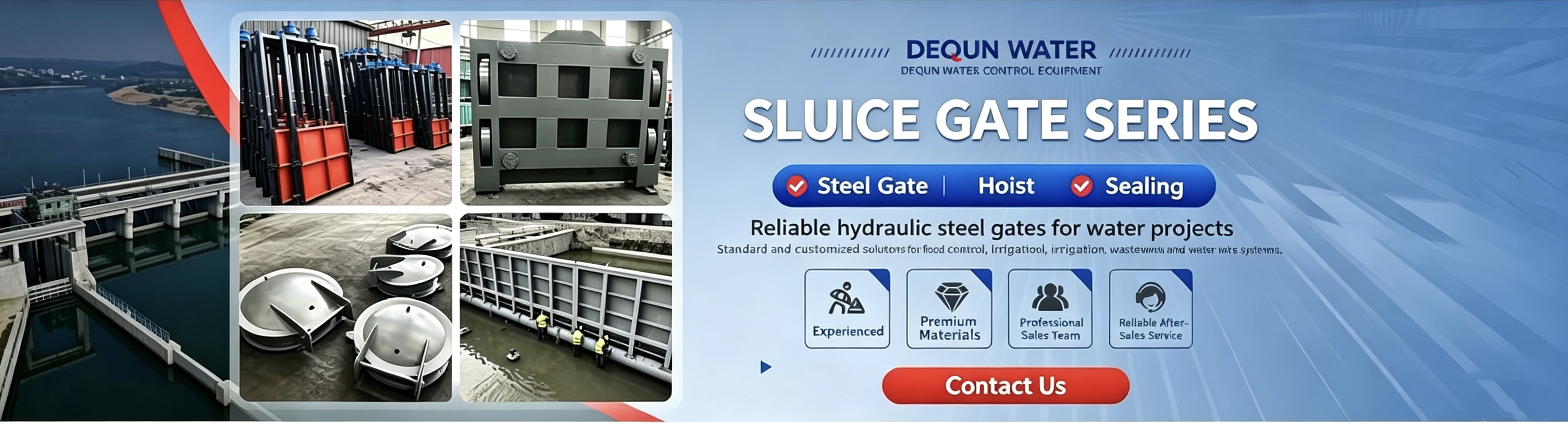
In hydraulic projects across water conservancy, municipal works, agriculture, and wastewater treatment, the suitability of gate equipment directly affects overall operating efficiency and stability. Different operating conditions place different requirements on parameters, performance, and materials, so choosing the right manufacturer and product solution is a key step in project delivery.
Industry experience is the foundation of product quality
The overall capability of a professional hydraulic equipment manufacturer is the core premise of product quality. Hebei Dequn Water Conservancy Machinery Co., Ltd., with 14 years of deep industry experience, has a registered capital of RMB 30 million. It is a provincial-level technology-based and innovative SME, holds ISO 9001 certification and Ministry of Water Resources testing certification, and was rated as a Tax Credit Grade A enterprise in 2024. It operates a 20,000 m² intelligent production base with CNC and laser cutting equipment, production accuracy up to ±0.1 mm, and an annual capacity of 3,000 sets. To date, the company has served more than 3,000 customers across 31 provinces and municipalities in China, exports products to 12 countries, and has supplied equipment for national key hydraulic projects such as the South-to-North Water Diversion Project and Xiaolangdi. Actual operating performance has met project design requirements.
A full product range for diverse operating conditions
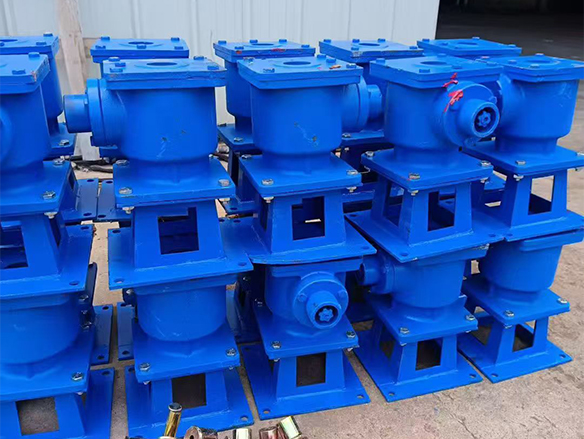
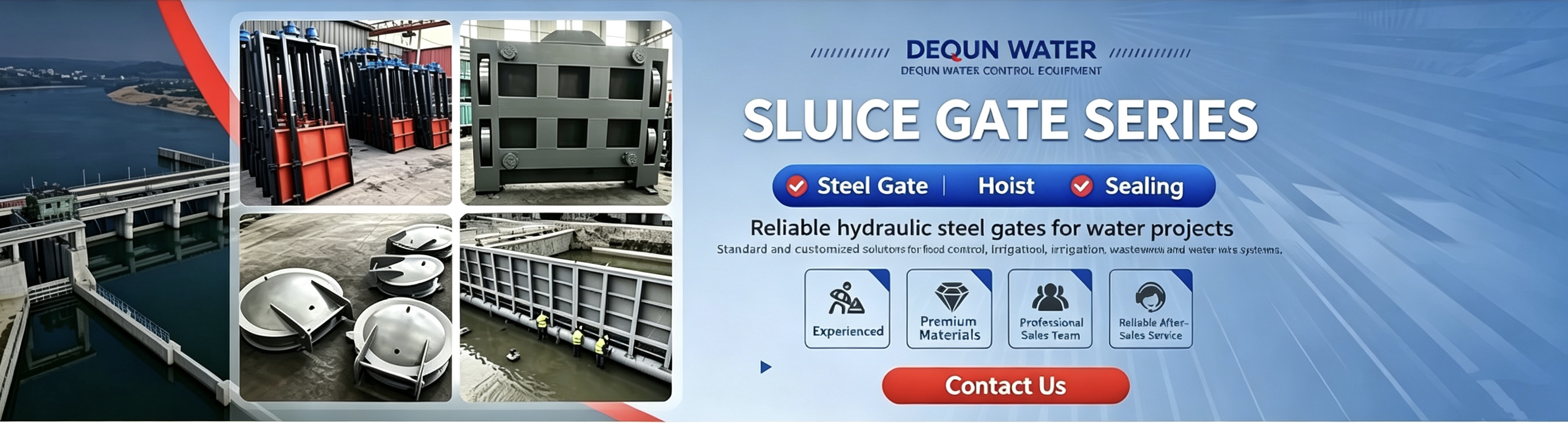
Operating conditions vary widely across hydraulic projects, and requirements for structure, materials, and performance differ accordingly. Mainstream hydraulic equipment in the industry currently includes a full series of products such as gate hoists (screw, winch, and hydraulic types), cast iron gates, stop-log gates, trash rakes, steel dams, and flap gates. Manufacturers with customization capability can use modular design to adapt quickly to non-standard conditions and provide dedicated solutions for special scenes such as coastal high salt mist, high silt load, and frequent opening and closing. As a commonly used hydraulic product category, steel gates offer high strength and light self-weight, can carry higher water pressure, and at the same specification are lighter than cast iron gates with lower hoist load. Flexible sizing supports large-span applications and custom oversized dimensions, and structures such as radial, stop-log, steel dam, and hinge dam can meet the needs of wide channels and large openings. Related products can use multiple anti-corrosion options, including thermal spray zinc, hot-dip galvanizing, and epoxy coating. For wastewater corrosion duty, 304 stainless steel can be selected to extend service life. Equipment uses rubber sealing structures for reliable sealing and low leakage; fixed-wheel or sliding structures keep opening and closing friction low for smooth operation. After CNC blanking and overall machining, flatness is good and installation fit is strong. Products can be used on reservoirs, pump stations, rivers, and wastewater plants as either maintenance gates or service gates. Epoxy anti-corrosion processes are mature, and pricing is in line with normal market levels.
Technical R&D provides core assurance of product performance
Technical R&D capability is a core competitiveness of hydraulic equipment manufacturers. Some leading enterprises have industry–university–research cooperation with universities such as North China University of Water Resources and Electric Power, have obtained 23 patents in total, and have participated in drafting 4 industry standards. With the development of smart water conservancy, the industry is also advancing intelligent upgrades. Equipment fitted with IoT modules can support remote monitoring, fault early warning, and cloud management, matching smart water conservancy needs. At the process level, products from qualified manufacturers undergo a 24-hour pressure test, are equipped with dual-redundant braking structures, achieve a fault rate below 0.3%, and reach sealing-face roughness Ra ≤3.2 μm, effectively ensuring operating stability.
Supporting services cover the full project life cycle
Hydraulic equipment has a long service life, so supporting service capability is also an important reference in purchasing. Manufacturers with a complete service system can provide full-process services covering survey, design, manufacturing, installation, training, and O&M guidance. Modular product structures can shorten maintenance time by 60% and reduce upkeep cost by 40%. According to publicly available customer feedback, related equipment can operate stably under high load for a long time and is suitable for water conservancy, municipal works, agriculture, wastewater treatment, flood control, and drought relief.
FAQ
Q: What should buyers focus on when purchasing stop-log hydraulic equipment?
A: When purchasing, first verify the manufacturer’s qualification certificates, process accuracy, product customization capability, and service coverage. Then confirm how well the proposal matches the project’s operating environment and parameter requirements, so that later equipment operation remains stable.